

SEO2026-06-24
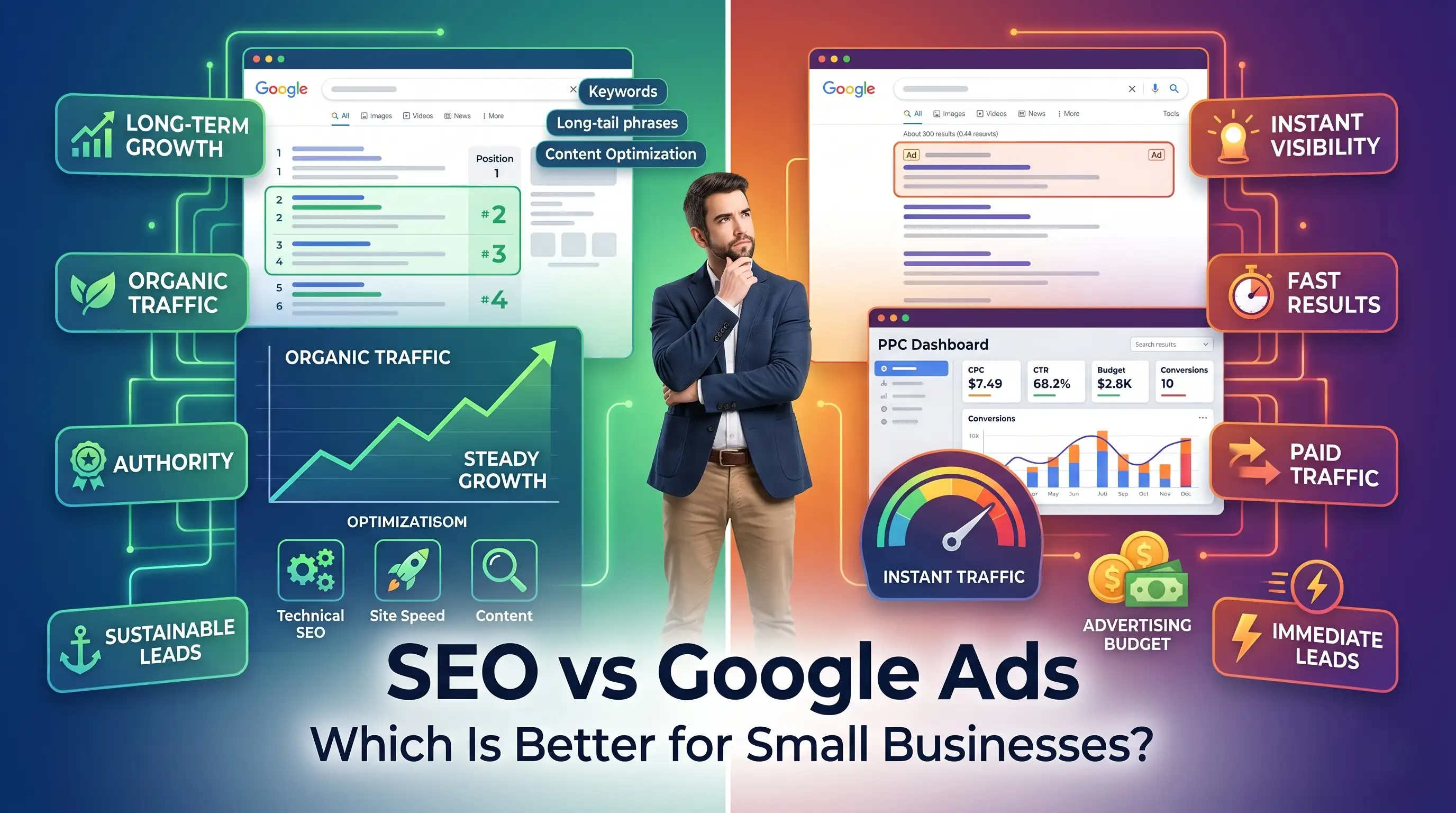
SEO vs Google Ads: Which Is Better for Small Businesses?
Compare SEO and Google Ads to understand costs, speed, ROI, and long-term business growth. Learn which strategy is right for your business.
Read Article →
A growing number of potential customers are not only using Google search anymore.
They are asking AI tools directly.
They may ask questions like:
These questions may now go to AI assistants, AI-powered search summaries, or conversational search tools instead of only traditional Google results.
This creates a new question for business owners:
How do you make sure your business is included in those AI-generated answers?
The honest answer is that AI search is still evolving. No one can guarantee exact visibility across every AI platform.
But there are practical steps you can take to make your website easier for AI systems to understand, summarize, and reference accurately.
This guide explains how to make your website AI search friendly without hype.
Making your website AI search friendly means structuring your content so AI systems can easily understand, extract, and accurately represent it.
This includes:
AI search optimization is not completely separate from SEO.
It builds on strong SEO fundamentals.
A website that is clear, helpful, credible, and technically strong is better prepared for both traditional search and AI-driven search.
AI search refers to search experiences powered by artificial intelligence.
This includes:
Traditional search usually gives users a list of links.
AI search often gives users a direct answer or summary.
This means users may get information without clicking many websites.
For businesses, the goal is not only to rank but also to be accurately included in AI-generated answers.
Traditional search shows a list of ranked website links.
AI search gives a summarized, conversational answer.
Traditional search usually requires users to click a website.
AI search may answer directly without a click.
Traditional search clearly shows website results.
AI search may or may not clearly show sources.
Traditional SEO often focuses on keyword-targeted pages.
AI search favors clear, well-structured, factual content that is easy to summarize.
Traditional SEO aims to rank and get clicks.
AI search readiness aims to help your business be understood, referenced, and represented accurately.
Businesses should care about AI search because customer behavior is changing.
People are starting to use AI tools for:
If your business information is unclear or inconsistent, AI tools may leave you out or represent your business incorrectly.
The good news is that many AI-friendly improvements also improve traditional SEO.
Clear content, good structure, fast websites, reviews, and consistent information help across both search types.
SEO helps your website rank in traditional search results.
It focuses on keywords, content, technical SEO, backlinks, and user experience.
AEO stands for Answer Engine Optimization.
It helps your content appear as a direct answer in featured snippets, voice search, People Also Ask, and similar answer formats.
GEO stands for Generative Engine Optimization.
It helps AI systems understand, summarize, and represent your business or content accurately in generated answers.
These three are connected.
Strong SEO is the foundation.
AEO improves direct answer visibility.
GEO prepares your content for AI-driven search and recommendation systems.
AI search systems generally look at content from multiple sources.
They may analyze:
The easier your content is to understand, the easier it is for AI systems to summarize it correctly.
If your website is vague, poorly structured, or inconsistent with other online sources, AI tools may misunderstand or ignore it.
Use clear headings such as H1, H2, and H3.
A logical page structure helps users, search engines, and AI systems understand what each page is about.
Avoid long pages without headings.
Write content that genuinely answers customer questions.
Do not write generic filler just to increase word count.
Helpful content is more likely to perform well in both SEO and AI search.
Answer important questions clearly near the beginning of each section.
Do not hide the main answer deep inside long paragraphs.
For example, if the heading is "What is Local SEO?", answer it directly first, then explain further.
FAQs are very useful for AI search.
They match how people naturally ask questions.
Good FAQ answers should be short, clear, and direct.
Link related pages together.
For example, a blog about Local SEO can link to your SEO Services page and Google visibility articles.
Internal linking helps AI systems and search engines understand your website structure.
If the topic needs expertise, show who wrote or reviewed the content.
This is especially important for legal, medical, financial, technical, or business advice topics.
Trust signals help users and search systems understand credibility.
Add:
Structured data, also called schema markup, helps search engines understand your content more clearly.
Useful schema types include:
A slow website hurts user experience and crawling efficiency.
Make your website load fast by optimizing images, scripts, hosting, and code.
Many AI-assisted searches and local searches happen on phones.
Your website should work smoothly on mobile devices.
Buttons, menus, forms, and contact options should be easy to use.
AI systems are designed to summarize useful and credible information.
If your content is vague, thin, copied, or keyword-stuffed, it becomes harder for AI tools to trust and represent it correctly.
Good content should be:
Do not write only for algorithms.
Write for real customers first, then structure it properly for search systems.
Start each important section with a clear answer.
Then explain details below.
Avoid unnecessary jargon.
Simple language helps both humans and AI systems understand your message.
Use clear headings for every topic.
This makes your content easier to scan and easier to process.
Do not make claims you cannot support.
AI systems may compare your content with other sources, so consistency matters.
Do not add paragraphs only to make the article longer.
Useful content is better than long but weak content.
Examples make content easier to understand and easier to summarize.
Your services, location, contact details, and brand information should match across your website and other platforms.
E-E-A-T stands for Experience, Expertise, Authoritativeness, and Trustworthiness.
These principles help evaluate content quality.
They also matter for AI search because AI systems need trustworthy information to summarize.
Experience means your content shows real involvement or practical knowledge.
Expertise means the content is created by someone who understands the topic.
Authoritativeness means your business or website is recognized as a credible source in your field.
Trustworthiness means your information is accurate, transparent, and consistent.
For business websites, trust can be improved through clear contact details, reviews, real examples, and honest content.
Schema markup is code added to your website to help search engines understand your content.
It explains what the content means, not just what it says.
For example, schema can tell search engines that a section is an FAQ, a review, a product, an article, or a local business.
Schema can help with:
For AI search, structured data can reduce confusion and make your information easier to interpret.
Generic content does not clearly answer user questions.
Specific, helpful content works better.
AI search still depends on websites being crawlable and accessible.
Speed, mobile usability, HTTPS, and clean structure matter.
Different names, phone numbers, services, or locations across the web can confuse search systems.
Without schema, search engines may still understand your content, but structured data makes it clearer.
AI-friendly websites still need SEO fundamentals.
SEO, AEO, and GEO work together.
Avoid shortcuts and unverified tricks.
Focus on clarity, credibility, usefulness, and technical quality.
Local businesses should focus on clarity and consistency.
Important steps include:
AI tools may use multiple sources to understand local businesses, so consistency is important.
AI search will continue to evolve.
Traditional search results, AI summaries, voice search, and conversational assistants will likely become more connected.
No one can perfectly predict how every AI platform will choose sources in the future.
But strong fundamentals will continue to matter.
Businesses should focus on:
This is a safer long-term strategy than chasing short-term AI tricks.
Use this checklist:
Making your website AI search friendly does not mean learning a completely new marketing system.
It means improving the fundamentals that already matter:
AI search tools need information they can understand and summarize accurately.
Your job is to make your website easy for both people and AI systems to understand.
If you want your website prepared for both Google and AI search, Drovixx can help.
We build websites and content structures based on SEO fundamentals, clear answers, schema markup, and AI-ready visibility.
Contact Drovixx to make your website search-friendly for the future.
It means your website is written and structured so AI systems can easily understand, extract, summarize, and represent your content accurately.
It is not completely different. It builds on SEO fundamentals with more focus on clarity, structure, FAQs, schema, and consistency.
Schema markup can help search systems understand your content more clearly, which may support AI search visibility.
Yes, reviews can support credibility, especially for local businesses and service providers.
Yes. Small businesses can compete by creating clear, specific, helpful content and maintaining strong local trust signals.
Not always. Start by improving structure, FAQs, content clarity, schema, and consistency step by step.
You can manually test relevant questions in AI tools and see whether your business is mentioned or represented correctly.
Drovixx helps improve website structure, SEO content, FAQ sections, schema markup, local visibility, and AI-ready content planning.
DROVIXX helps businesses build professional websites, improve Google visibility through SEO, and develop modern mobile applications.
Explore more insights from DROVIXX about business growth, websites, SEO, and app development.
Compare SEO and Google Ads to understand costs, speed, ROI, and long-term business growth. Learn which strategy is right for your business.
Read Article →
A practical local SEO guide for small businesses covering Google Maps rankings, Google Business Profile setup, reviews, and local visibility.
Read Article →
Can't find your business on Google? Learn the common reasons and practical fixes for your website, SEO, and Google Business Profile.
Read Article →